
Do You Know Who the Real Musketeers Were?
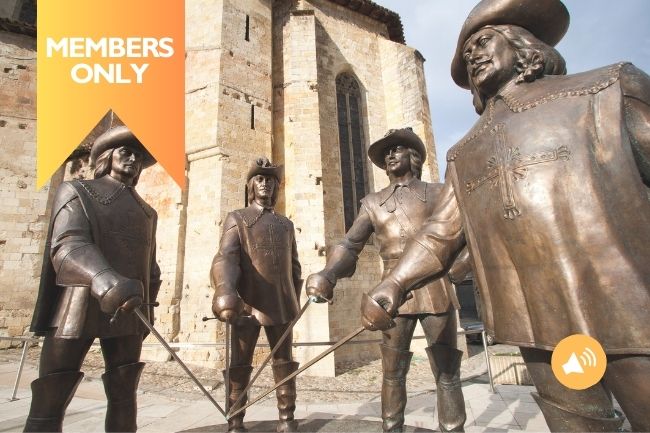

How much historical truth lies behind Alexandre Dumas’ famous fiction?
📢 As you scroll through the beautiful images, why not listen to our narrated article? It’s a great way for France Today Members to dive deeper into the story while enjoying the visuals. We hope you love this experience, and we’d love to hear what you think—feel free to share your thoughts in the comments below! Happy listening!
Alexandre Dumas’ 1844 novel The Three Musketeers is a much-loved masterpiece of camaraderie and derring do. But did you know that the exploits of D’Artagnan, Athos, Porthos and Aramis were inspired by real-life brothers-in-arms whose lives were as captivating as any tale Dumas could tell?
Dumas found his hero in a time-worn copy of Courtilz de Sandras’ fictional Memoirs of Monsieur d’Artagnan. In these pages, the author not only discovered d’Artagnan, but the amazing back-stories of three quick-witted soldiers. In this mash-up of fact and fiction, the teenage D’Artagnan leaves his poor but noble family behind to seek his fortune with the King’s Guards in Paris. Though brave and eager, d’Artagnan is an inexperienced hothead. He becomes entrenched in the affairs of the French court, and is soon befriended by Athos, Porthos and Aramis.
D’Artagnan’s historical counterpart, Charles de Batz de Castelmore, was born into a newly ennobled family. Like Dumas’ hero, he was loyal, courageous and enterprising and risked his life to protect Louis XIV. Using his mother’s name, d’Artagnan, as his nom de guerre, de Castelmore became the captain of the King’s Musketeers in 1656 and undertook secret missions that warranted the utmost discretion. In recognition of his loyal service, he was awarded various honours, including being appointed Capitaine concierge of the Royal Aviary. He was killed at the Siege of Maastricht on June 25, 1673.
As the leader of the three musketeers, the fictional Athos is known for his precise sword fighting, but, tortured by a devastating secret, drowns his sorrows in wine and engages in brawls with strangers. In real life, Armand de Sillègue took the name Armand d’Athos from his village in the Pyrénées-Atlantiques. He became a musketeer in 1640, and died in a duel three years later. He was buried at the Pré aux Clercs near Paris and his death records are kept in the nearby Church of Saint-Sulpice.

The Musketeers, Maurice Leloir
True-life inspiration
Porthos is the story’s comic relief. His outstanding physical strength is echoed by his large appetite. A slave to fashion, he is as vain as he is brash. The real Isaac de Porthau was well-connected; he was the cousin not only of Athos, but of the Comte de Troisville, captain of the King’s Guards, whom Dumas wove into the story as Monsieur de Tréville. Porthau became a musketeer in 1642 but quit the Royal household in 1654 to become a parliamentarian in his home town of Béarn. He died in Pau in 1712 at the grand old age of 95.
Melodramatic and hot tempered, Dumas’ Aramis, the handsomest of the trio, wavers between his religious leanings and his affection for women and the intrigues of court. In real life, Henri d’Aramitz was born into an aristocratic family and became a musketeer in around 1640. Previously a lay-abbot at the abbey bearing his family name, Aramitz served several years as a musketeer, but apart from his death date of 1657, his career is unrecorded. All for one, and one for all the lives of these four men came together to form one great tale.
From France Today Magazine
Ohlala! It looks like you’re not a Member yet
Join to view this content!
(If you are a Member, log in or reset your password below or contact us so we can help)
- Log in
- Forgot password
Share to: Facebook Twitter LinkedIn Email
More in France Today Membership, French culture, French history, french literature, musketeers
Related Posts



By Hazel Smith
Leave a reply
Your email address will not be published. Required fields are marked *